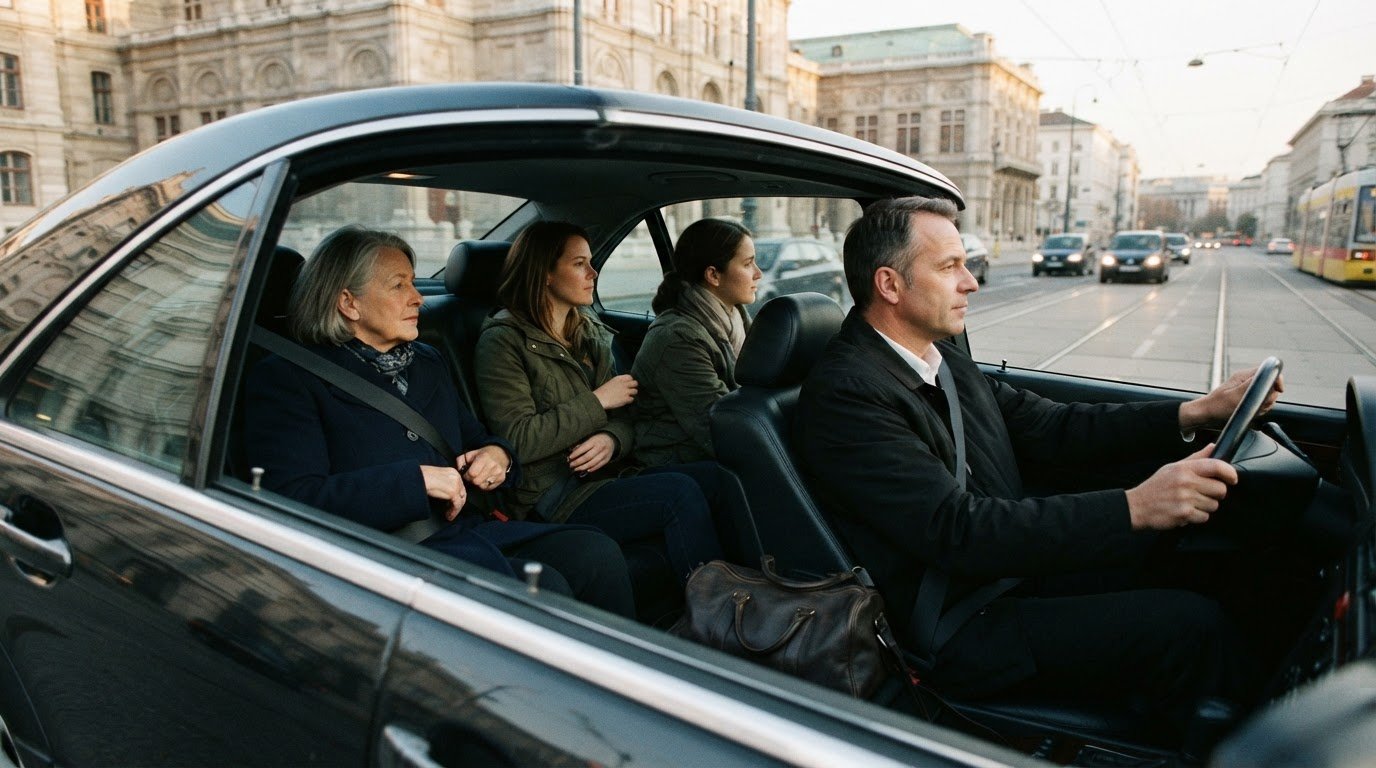
The cheapest journey isn’t always the easiest. Public transport is often the lower-cost choice for solo travellers and city sightseeing, but is a private transfer worth it in Europe when you’re travelling with family, a group, or an older passenger? The answer depends on more than the fare: luggage, connections, flexibility, and how close you need to get to your destination all matter.
Both options have their place. A train or city tram can make getting around simple, while a private door-to-door journey can spare you the hassle of changing connections and carrying bags between them. This article compares cost and convenience, explains when each option makes sense, and helps families, groups, and older travellers choose a journey that suits their needs. Combining public transport in cities with private transfers for selected journeys can also be a practical approach.
Key Takeaways
- Choose public transport for straightforward city trips and when keeping individual travel costs low matters most.
- Weigh luggage, connections, departure timing, and the needs of your travel party before choosing transport between destinations.
- For families, groups, and older passengers, fewer changes and a direct journey can make the trip easier to manage.
- Use a mix of trains and city transport with private door-to-door transfers where convenience matters most.
Private Transfer vs Public Transport in Europe: Which Should You Choose?
Whether a private transfer is worth it in Europe depends on your route, travel party, luggage, and priorities. Compare the complete journey, including connections and the distance from your arrival point to your final destination.
Private Transfer Comfort and Luggage Help
A private transfer gives your party a vehicle for direct travel between the pickup point and destination. You avoid carrying luggage between train platforms, and the driver can assist with bags. Public transport offers less privacy and may mean handling luggage through stations. In Budapest, for example, metro and tram services can suit sightseeing, while a direct ride may be more convenient if you have several suitcases.
Private Transfer Costs
There is no single average private-transfer cost across Europe. The fare depends on the route, vehicle, and journey details. Airport-to-city-centre prices also vary by distance and destination. To judge whether a private transfer is worth it in Europe, compare the total cost with the separate fares for everyone travelling, rather than looking at just one ticket. Public transport is usually the cheapest option for getting around many European cities.
Choosing by Budget and Travel Needs
Start with your journey’s main priority. A solo traveller heading into a city may favour public transport, while a group with bulky luggage may value a direct ride. When arranging a transfer, share the number of passengers, luggage details, and any child-seat requirements. Compare train connections with pickup and drop-off convenience. High-speed trains are often the quickest and most comfortable option between major European cities.
| Option | Budget | Luggage and comfort | Best fit |
|---|---|---|---|
| Public transport | Often lower | Manage bags and connections | City sightseeing |
| Private transfer | Depends on route and party | Direct, private journey | Groups or heavier luggage |
Choose public transport for city trips and lower fares; choose a transfer when direct travel matters more.
Travel with families, groups, or elderly passengers
For families, groups, and older passengers, compare every leg of the journey, not just the main route. In Hungary, station access, luggage, and the distance from the station to your accommodation can all affect how manageable the trip feels.
Family and Group Travel
A private ride keeps your party together, without the need to coordinate separate train departures or meeting points. If you’re travelling with children, share the passenger count and child-seat requirements when arranging transport. For a group, describe the luggage as well as the number of passengers, since both affect planning. An older traveller may prefer fewer walks through stations and less time handling bags during changes.
Public transport can still suit a group travelling light on a straightforward route. The choice depends on how much coordination your party is comfortable handling.
Door-to-Door Travel with Fewer Connections
A door-to-door journey connects the agreed pickup point directly to your destination, avoiding train changes and the need to carry luggage between connections. For example, an airport arrival followed by a hotel transfer can be planned as one journey instead of separate legs through a station. This can simplify travel for passengers with limited mobility or families managing children and bags.
Recent traveller reviews can offer useful insights into a provider’s service. Look for accounts describing needs similar to yours, such as airport pickups, luggage handling, clear communication, and journeys with older passengers. Specific experiences can help you judge whether the service fits your plans better than a general rating alone.
Private door-to-door transfers across Europe
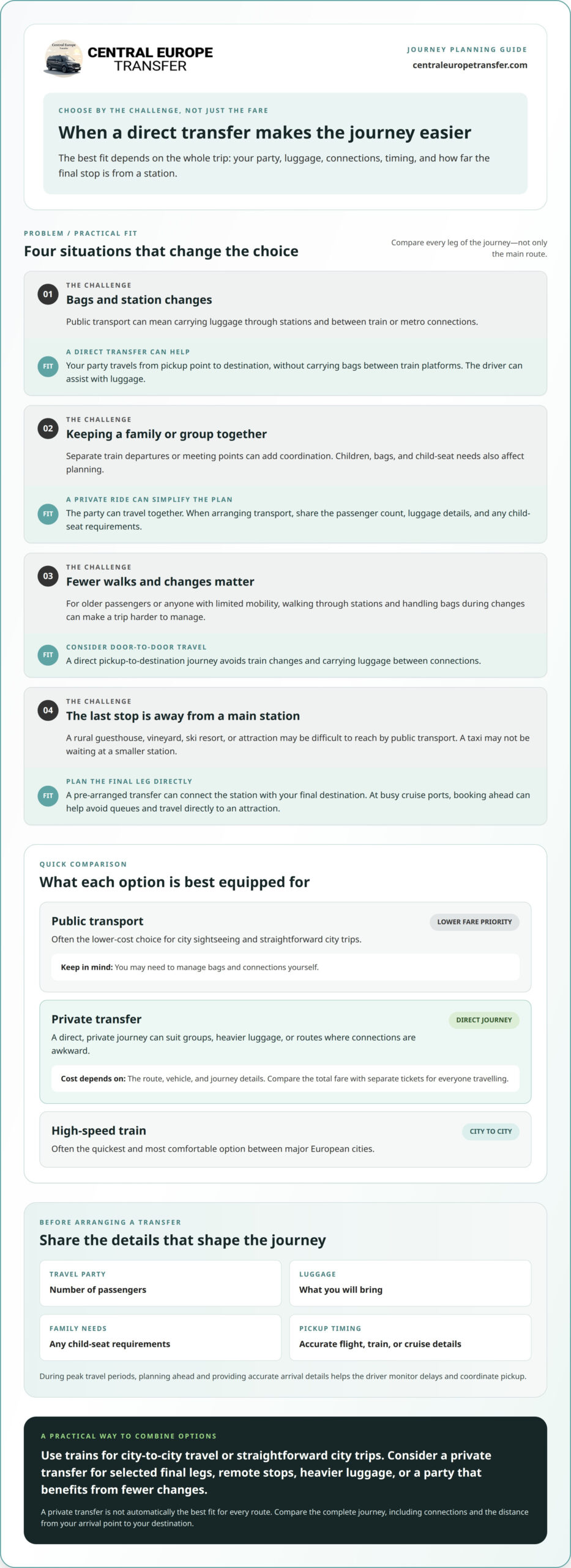
A door-to-door transfer connects your chosen pickup point directly with your destination. It avoids train changes and carrying luggage between connections, which can make the journey more practical when your hotel, countryside stay, or attraction is away from a main station.
Consider a rural guesthouse, vineyard, or ski resort reached from a smaller train station. Public transport may be limited there, and a taxi may not be waiting when you arrive. A pre-arranged transfer can take you from the station to your final destination. At busy cruise ports, booking ahead can also help you avoid queues and travel directly to an attraction.
Timing matters, too. During peak travel periods, book in advance and provide accurate flight, train, or cruise details. This helps the driver monitor delays and coordinate the pickup. For an airport journey, you can plan around your arrival details instead of arranging each onward leg separately.
Private transfers are not automatically the best choice for every route. High-speed trains are often the quickest and most comfortable option between major European cities. Public transport can also work well for city sightseeing, while a transfer may suit a remote destination or a route with awkward connections. Combining trains for city-to-city travel with private rides for selected final legs can keep an itinerary practical.
For a planned journey from Budapest, arrange a door-to-door transfer that fits your route and stops.
CentralEuropeTransfer: sightseeing transfers from door- to- door
CentralEuropeTransfer offers door-to-door sightseeing transfers for travellers who want a direct journey with planned stops. Choose this option when public transport doesn’t suit your route or you’d rather travel between destinations without changing connections.
For example, a Budapest to Vienna Transfer or Budapest to Prague Transfer can connect your pickup point with your destination. Private Day Trips suit travellers who want to include sightseeing stops along the way. Share your route and preferred stops when arranging your journey so the trip can be planned around your needs.
Contact CentralEuropeTransfer to discuss a door-to-door journey that suits your itinerary.
Make your next journey fit your plans
Whether a private transfer is worth it in Europe depends on which part of your itinerary you want to make easier. Start with your next leg: decide whether direct travel, planned sightseeing, or public transport best suits the day. Setting a clear priority makes your transport choice more purposeful.
For travel to or from Budapest, CentralEuropeTransfer offers Budapest to Vienna Transfer, Budapest to Prague Transfer, and Private Day Trips. These options can suit a direct city-to-city journey or a day that includes sightseeing. Choose the route that fits your plans, then shape the rest of your itinerary around the experience you want.
Ready to discuss your travel plans? Get in touch with CentralEuropeTransfer and take the next step toward a journey designed around your trip.
Frequently Asked Questions
What if my plans change?
For CentralEuropeTransfer bookings, the latest you can cancel your trip for free is 24 hours prior to the start of your trip. If your plans change closer to departure, the free-cancellation rule does not establish what happens next. Review the booking terms for changes or cancellations outside that window, and keep your itinerary details handy when arranging any update.
What is included in the price?
CentralEuropeTransfer provides door-to-door private car transfers at a fixed price per trip. The vehicles are smoke-free, air-conditioned, clean, and comfortable, with English-speaking drivers. There’s no need to pay upfront; you can pay at the end of the trip. A Budapest Airport Transfer takes you directly from the arrivals terminal to a destination in or around Budapest.
How do private transfer prices compare with taxis, ride-hailing, trains, and buses in Europe?
There is no single price comparison for every European route. Trains and buses charge their own fares, while taxis and ride-hailing services may price a vehicle journey differently from a pre-booked fixed-price transfer. Compare the total for your party, not just one passenger’s ticket. CentralEuropeTransfer charges a fixed price per trip, rather than a per-person fare.
When is a private transfer worth the extra cost in Europe?
A private transfer can be worthwhile when the value of a direct, private journey matters more to you than choosing the lowest-cost option. For example, a family arriving with luggage may prefer one arranged ride to several separate legs. A transfer can also suit passengers heading to a destination that is difficult to reach by public transport. For a simple city sightseeing day, public transport may be a better fit.
Are private transfers in Europe licensed, insured, and regulated?
There is no single answer for every European country or route. Licensing and insurance requirements depend on the jurisdiction and type of passenger transport, so a private booking alone doesn’t establish a vehicle’s or operator’s status. For journeys crossing borders, consider the rules relevant to each country along the route. Don’t assume that one country’s requirements automatically apply throughout Europe.
Published: 2026 november 24